The two ants get confused constantly, and the treatment for one makes the other worse. Carpenter ants are large — a quarter inch or more — and dump frass, which looks like pencil shavings mixed with insect legs, under…
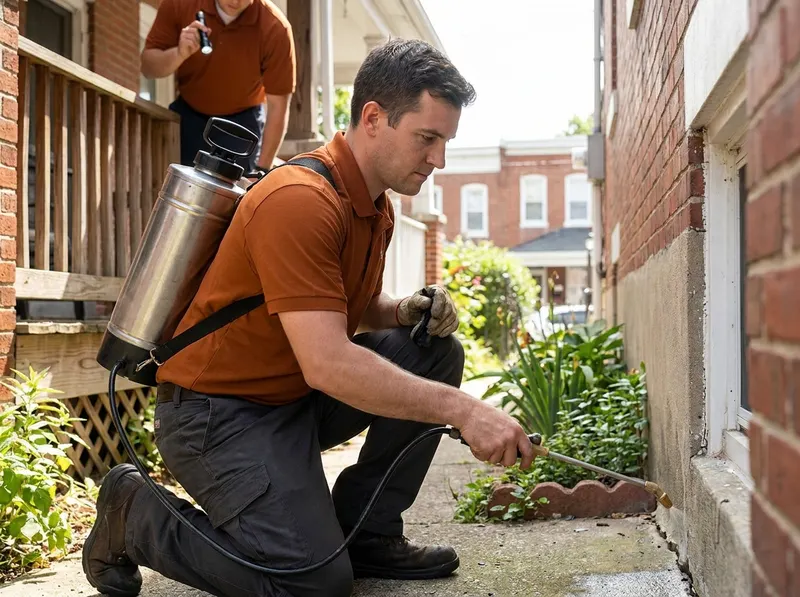
The two ants get confused constantly, and the treatment for one makes the other worse. Carpenter ants are large — a quarter inch or more — and dump frass, which looks like pencil shavings mixed with insect legs, under a window sill, below a basement joist or at the base of a door frame. They do not eat wood; they hollow out wood that is already soft, which in Baltimore almost always traces back to a specific water path: a clogged built-in gutter behind a parapet, a failed cornice return, a rear addition roof in Hampden, a window air conditioner that has been dripping into the sash for three summers, or the flat-roof kitchen bump-out common on Canton and Highlandtown rows. Find the leak and you find the nest. Odorous house ants are small, dark and relentless, trailing along caulk lines, countertop grout, the dishwasher supply line and sidewalk expansion joints, and their colonies keep dozens of queens.
That is where the decision-fit lives. A repellent contact spray on an odorous house ant trail kills the workers you can see and triggers budding — the colony splits and re-forms in two or three new spots, often deeper into a shared party wall where the next owner inherits it. So for odorous house ants we lead with non-repellent baits and slow-acting actives the foragers carry home, placed in cracks, under appliances and in tamper-resistant exterior placements away from kids and pets. For carpenter ants, baiting alone is slower and less reliable, so the work shifts to locating satellite nests and treating voids directly, then correcting the moisture. Spraying the whole basement is the alternative most people have already paid for, and it is why the ants came back in three weeks.
Baltimore's building stock stacks the deck. Attached rows share brick walls, so a nest above a neighbor's ceiling feeds ants into your kitchen — one reason we inspect the full exterior envelope and, in converted 2–4 unit buildings around Mount Vernon and Bolton Hill, ask to see the basement and top floor together. Mature street trees in Roland Park, Charles Village and around Patterson Park keep aphids producing honeydew, and odorous house ants farm it, then follow branch contact onto a roof or a formstone face. Locust Point and Fells Point add damp harbor air and older wood trim near the water. Carpenter ant swarmers usually show up indoors in spring, and a winged ant inside in March or April means an active nest in the structure, not one outside.
Exclusion is the part that holds. After treatment we seal what is accessible and sensible — utility penetrations, sill and mudsill gaps, cornice and soffit openings, gaps behind downspout straps — and tell you plainly what needs a carpenter or roofer instead. We do not perform structural wood repair or roofing, and we will not claim a spray substitutes for it. Follow-up is built into an ant scope because a multi-queen colony is judged over weeks, not on the day we leave. Sealed out, not just sprayed.
Every job gets a firm, written price after a free on-site visit.
Tell us about your carpenter ant and odorous house ant control job in Baltimore and we'll send a clear, written quote — usually the same day.
 Elvanta Pest Control Service