Baltimore's alley grid is what makes Norway rats a structural problem here rather than a one-house problem. The rear of a Canton or Highlandtown rowhome gives a rat everything it needs inside a 30-foot radius: a shaded…
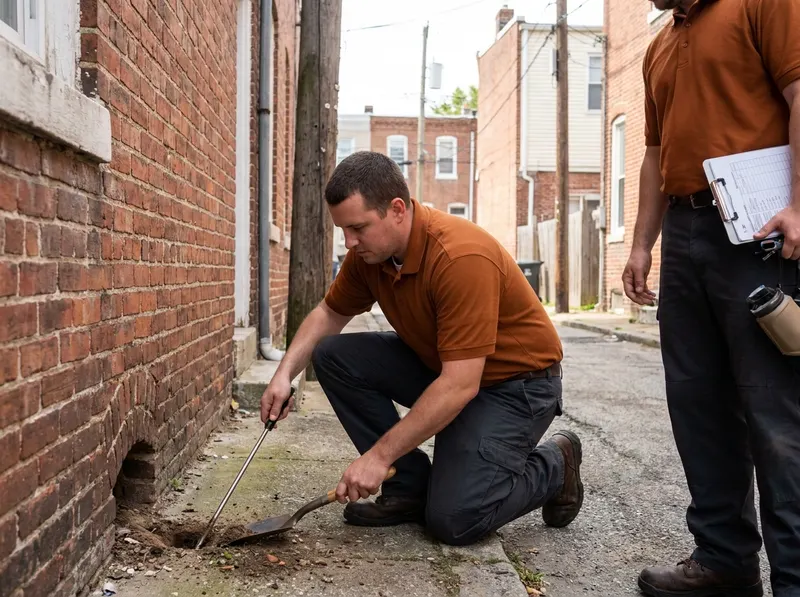
Baltimore's alley grid is what makes Norway rats a structural problem here rather than a one-house problem. The rear of a Canton or Highlandtown rowhome gives a rat everything it needs inside a 30-foot radius: a shaded gap under a concrete pad, a fence line thick with ivy, cans that get set out the night before pickup, and a hard-packed dirt strip against the foundation. Burrow entrances run roughly 2 to 4 inches across, usually within a few feet of cover, and a single system can have several openings and a bolt hole you will not see from standing height. We get low, count the holes, mark which ones are active by rub-polished soil and fresh spoil, then collapse and block them — backfill with gravel or hardware cloth rather than loose dirt, which a rat re-opens overnight.
The indoor half of the job is where most previous treatments failed. A Norway rat can pass through a gap of about a half inch, and a rowhome basement is full of them: mortar washed out of the alley-facing wall, an old coal chute, the sill plate above a stone foundation, an abandoned drain line, the gap behind a rear door threshold that has settled. Sealing those openings is what stops the return trip; bait alone never does. In Federal Hill, Fells Point and Locust Point we also look at joist pockets against the party wall, because a rat that cannot get into your basement will simply use next door's and come through the shared wall at the top of the block wall.
When does this service fit, and when does something else? Exterior burrow work plus sealing is the right call when you are seeing droppings in the yard, holes in the alley, gnawed trash cans, or hearing heavy movement in the basement ceiling — that is Norway rat behavior and it is treatable from outside in. If the activity is small, dry droppings in upper-floor cabinets and scratching in a second-floor wall, that is more likely mice, and the work shifts to interior trapping and small-gap sealing instead. The trade-off with exterior-only service is honest: it is cheaper and it drops the population fast, but if the entry gaps stay open, a neighbor's burrow refills your basement in a season. Sealing costs more up front and holds.
One more Baltimore reality worth saying plainly: your property line is not the rat's territory. Blocks near Patterson Park, the alleys off 36th Street in Hampden, and the mixed-use stretches around Mount Vernon and Charles Village usually have pressure from two or three yards at once, and restaurant-adjacent alleys reload constantly. Baltimore City is an independent city that is not part of any county, so rodent complaints and sanitation issues go to city services rather than a county health department — we will tell you when a neighbor's condition or a city-side issue is the real driver, and note it in your scope so you have something in writing for a landlord, an HOA or a co-owner. On billing, you are not signed into anything you cannot cancel: we quote the rat job, and ongoing exterior monitoring is optional for blocks with steady alley pressure. Sealed out, not just sprayed.
Every job gets a firm, written price after a free on-site visit.
Tell us about your norway rat control and alley burrow work job in Baltimore and we'll send a clear, written quote — usually the same day.
 Elvanta Pest Control Service