The mosquito biting your ankles at 4pm on a Canton patio is almost never coming from a swamp. Asian tiger mosquitoes are container breeders and daytime biters, and they will complete a generation in a plant saucer, a…
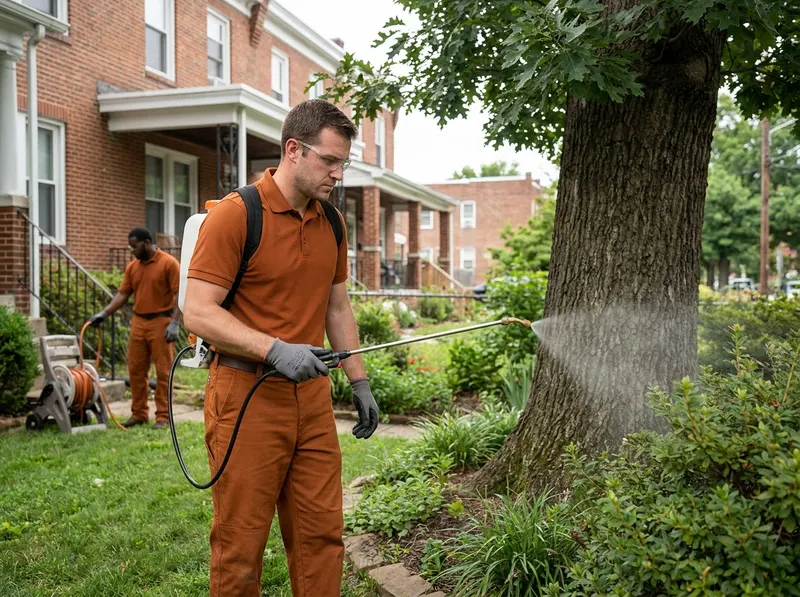
The mosquito biting your ankles at 4pm on a Canton patio is almost never coming from a swamp. Asian tiger mosquitoes are container breeders and daytime biters, and they will complete a generation in a plant saucer, a forgotten paint bucket, or a half-inch of water in the bottom of a recycling bin. In attached rowhome blocks from Fells Point up through Highlandtown, the breeding container is frequently on the other side of your fence or sitting in the shared alley — which is why a yard that gets sprayed and nothing else feels good for ten days and then feels exactly like it did before. We treat the yard we can reach and tell you plainly which containers off your property are still feeding the population, because a homeowner who knows where the water is can pour it out weekly for free.
Ticks behave differently and belong to a different part of the city. A 12-by-20 concrete pad in Locust Point or Federal Hill with two potted figs is a mosquito problem, not a tick problem. Tick pressure shows up where lawns meet unmown edge habitat and leaf litter — the wooded margins near Gwynns Falls Leakin Park, the deeper lots and hedgerows in Roland Park, backyards that back onto the tree line at Druid Hill Park or Cylburn Arboretum, and dog-walking routes through the perimeter brush at Patterson Park. For those properties the application shifts to the ground: the first few feet of leaf litter inside the tree line, stone walls, and along the fence, rather than a broadcast spray of open turf where ticks don't live.
So the decision is usually between a single treatment and a repeating one. A single visit fits a specific date — a graduation party in Hampden, a Bolton Hill wedding reception in the garden, a rental showing where the back patio has to look and feel usable. A residual barrier knocks down resting adults and holds for roughly two to four weeks depending on rainfall, and Baltimore's July thunderstorms shorten that. Repeat visits every three to four weeks from late April into October fit households that actually live outside — a Charles Village family with a toddler in the yard daily, a dog owner in Mount Vernon walking through park edges twice a day. The trade-off is honest and worth saying out loud: one treatment is a date, a program is a season, and no outdoor product eliminates every mosquito in an open-air city block. What it does is drop the population enough that the yard stops being unusable.
We are not going to sell you a monthly plan you can't leave. Scope, visit count, and what each visit covers are written down before work starts, and if the problem is solved you stop. For landlords and multi-unit owners, that written scope is also what a tenant asks for — a dated record of what was applied outdoors and when the yard was safe to use again. Sealed out, not just sprayed applies to yards too: drain the water, treat the harborage, then come back and check.
Every job gets a firm, written price after a free on-site visit.
Tell us about your mosquito and tick yard treatment job in Baltimore and we'll send a clear, written quote — usually the same day.
 Elvanta Pest Control Service