Elvanta Pest Control ServiceElvanta Pest Control Service

Yellowjacket and Hornet Nest Removal

Baltimore's rowhome stock creates two very different jobs, and the right one depends on where the colony sits. An aerial bald-faced hornet nest — the gray football-shaped paper nest — hangs in an open spot: a Roland…
Call (667) 309-5283 →(667) 309-5283
Yellowjacket and Hornet Nest Removal in Baltimore, MD
Quick answer
  • Included: on-site inspection to locate the nest and its entry hole, treatment of the active colony, removal of accessible aerial nests, sealing of the void opening where structurally possible, and written notes on re-entry timing for kids and pets.
  • Timing: most Baltimore stinging-insect calls are scheduled same week, and single-nest visits typically take 30 to 60 minutes on site.
  • Cost: ballpark $250 to $650 for most single-nest jobs in Baltimore; $250 is the minimum charge for any stinging-insect visit.
  • We handle yellowjackets in ground and wall voids, bald-faced hornets in aerial paper nests, European hornets in soffits and tree hollows, and paper wasps under railings, eaves and grills.
  • To book: call (667) 309-5283, describe where you see wasps entering, and we schedule a free on-site look that confirms the exact price before any work begins.

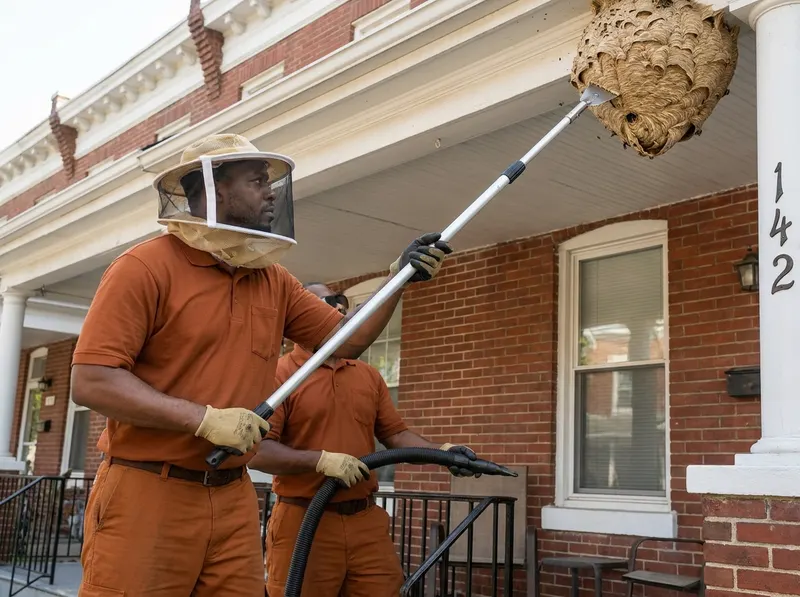
Baltimore's rowhome stock creates two very different jobs, and the right one depends on where the colony sits. An aerial bald-faced hornet nest — the gray football-shaped paper nest — hangs in an open spot: a Roland Park hemlock, a Charles Village porch ceiling, the underside of a Canton roof deck. Those are treated and physically taken down, and the job usually ends there because wasps never reuse an old nest. A yellowjacket colony behind formstone, in a Federal Hill cornice return, or under a Hampden back-porch step is the harder job. The insects you see going in at the second-story roofline may be traveling several feet inside the wall cavity to a nest you cannot reach. That kind of colony needs a dust applied at the true entry point so returning foragers carry it in, then a wait of several days before the hole is sealed. Sealing first is the classic mistake — trapped yellowjackets look for a second exit, and in an attached house the second exit is often your neighbor's closet or your own kitchen ceiling.

Ground nests behave differently again. Yellowjackets in Baltimore commonly take over old rodent burrows, the gap under alley pavers, or loose soil along a mulch bed — the strip between a Locust Point patio and the fence line is a classic spot. Ground colonies are treated at the tunnel opening, usually in the early morning or after dusk when foragers are home, and the hole is then closed with soil or stone so nothing re-excavates it. If the nest sits within a few feet of a back gate, a shared alley trash pad, or a stoop where kids come and going, say so when you call; proximity changes how we stage the visit and when the area is safe to walk again.

Season drives everything here. Overwintered queens start small nests in April and May, colonies grow quietly through July, then peak in late August and September — which is exactly when Fells Point and Highlandtown calls spike, because thousands of workers are hunting sugar around alley cans, outdoor tables and recycling bins. Late-season colonies are the largest and the most defensive, and they are also the ones most likely to be found by a homeowner on a ladder. Baltimore's first hard frost kills the workers and the colony dies on its own, so a nest discovered in November in an unreachable tree is often better left alone than paid for. We will tell you that on site rather than sell you a treatment. What we will not skip is the exclusion step: rowhome soffits, chimney flashing, and gaps around Bolton Hill window casings that hosted a colony this year will host one next year unless the opening is closed.

What it costs

Single accessible aerial nest (porch ceiling, eave, shrub, tree under 15 ft)$250 - $375
Ground nest in yard, mulch bed, alley pad or under stoop$250 - $400
Yellowjacket or hornet colony in soffit, cornice or wall void (dust treatment + follow-up seal)$325 - $550
Third-story roofline or chimney-area nest requiring extension ladder work$375 - $650
Two or more active nests on one property (house plus garage, fence or alley shed)$450 - $850
Added exclusion sealing of the entry void after colony is inactive$250–$300
Return visit if activity continues at the same nest siteFrom $250

Every job gets a firm, written price after a free on-site visit.

Common questions

How fast can someone remove a yellowjacket nest in Baltimore?
Most Baltimore stinging-insect visits are scheduled within the same week, and ground or aerial nests are typically handled in a single 30 to 60 minute visit. Call (667) 309-5283 and describe the location — a nest at a doorway, stoop or shared alley gate gets priority over one at the back of a yard.
Why can't I get an exact hornet removal price over the phone in Baltimore?
Price depends on facts only visible on site: nest height, whether the colony is exposed or inside a Baltimore rowhome wall void, ladder access from a narrow alley, and how many entry points the wasps are using. We give an honest ballpark on the phone — $250 minimum, most single nests $250 to $650 — and confirm the exact figure during a free on-site look before any work starts.
Will the wasps come back to the same spot on my Baltimore rowhome?
Wasps never reuse the old paper nest, but they do reuse the same structural gap. Baltimore rowhomes lose colonies to the same soffit seam, cornice return or loose formstone edge year after year, which is why sealing the opening after the colony is inactive is part of the job rather than an upsell we skip.
Is yellowjacket treatment safe for kids and pets in a Baltimore rowhome?
Products are applied at the nest and entry point, not broadcast across living space, and we leave written re-entry timing for the treated area before we drive off. For ground nests near a Canton or Locust Point patio, keep pets and children off that strip of yard for the interval stated on the paperwork.
Do I still need hornet nest removal in Baltimore in October or November?
Often not. Baltimore's first hard frost ends the worker population and the colony dies without treatment, so a high, out-of-reach nest found in late fall is frequently something we advise leaving alone. Treatment is still worth it in autumn when the nest sits at a door, stoop, deck, or wall void where people are still getting stung.

Ready to get started?

Tell us about your yellowjacket and hornet nest removal job in Baltimore and we'll send a clear, written quote — usually the same day.