Attached housing changes the math on mice. In a Canton or Locust Point rowhome, the party wall you share with the neighbor is usually brick with joist pockets cut into it, and those pockets line up floor to floor. Mice…
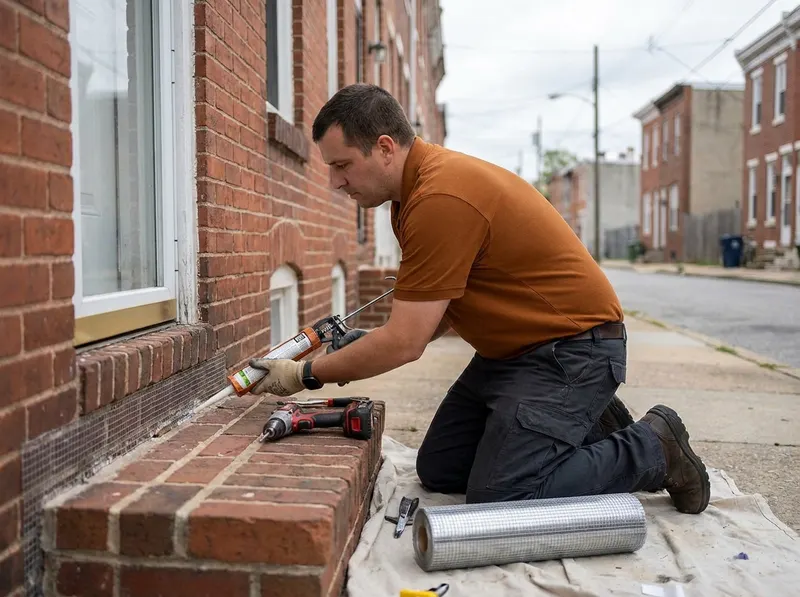
Attached housing changes the math on mice. In a Canton or Locust Point rowhome, the party wall you share with the neighbor is usually brick with joist pockets cut into it, and those pockets line up floor to floor. Mice use them as a stairwell. That is why a homeowner can trap six mice in a week, hear nothing for ten days, and then hear scratching again above the kitchen ceiling — the population next door is still intact and the highway between the two houses was never closed. Our scope always covers the shared-wall side, not just the exterior front and rear. In Fells Point and parts of Federal Hill, the foundations are older rubble stone with mortar loss at the sill plate, so sealing there means repointing-style mortar work and hardware cloth rather than a bead of caulk.
The common Baltimore entry points are predictable once you know where to look: the gap around the water service line and gas line where they pass through the alley-facing basement wall, the BGE meter penetration, the dryer vent hood with a broken flapper, the cellar door threshold on the alley, the chewed corner of a wooden basement door, and the mortar joint behind the rear stoop. In Hampden's mixed frame-and-brick blocks, add the porch skirt and the gap where a later kitchen addition meets the original rear wall. In converted multi-unit buildings around Mount Vernon, Bolton Hill and Charles Village, the shared plumbing riser and the vertical chase behind stacked kitchens carry mice from a basement laundry to a third-floor unit without them ever crossing a hallway.
Exclusion fits when activity is recurring, seasonal, or shared with neighbors — which describes most attached homes from October through February, when overnight temperatures in Baltimore drop and mice press indoors toward heat and food. Trapping-only service fits a narrower case: a single mouse that came in through a propped door in a detached Roland Park house, no droppings elsewhere, no gnaw damage. The trade-off is honest. Trapping is cheaper up front and can clear what is already inside within days, but it does nothing about the opening. Exclusion costs more on the first visit and does not kill the mice already in the wall, which is why the two are sold together. Sealed out, not just sprayed is the whole point: bait volume is not a strategy in a rowhome block.
We also handle the parts other companies leave vague. Every job ends with a written list of sealed locations and the materials used, so you can show a landlord, a buyer's inspector, or the neighbor you are trying to get on board. Re-entry timing for any interior product used is stated out loud before we apply it, along with placement away from pet and child access. Mouse work is quoted as a defined scope with a stated number of follow-up visits, not an open-ended monthly subscription — ask about terms when you call and you will get a straight answer. If the source turns out to be a neighboring property or an alley trash condition rather than your structure, we will say that too, because Baltimore City rowhome blocks are one connected system and pretending otherwise wastes your money.
Every job gets a firm, written price after a free on-site visit.
Tell us about your mouse control and party-wall exclusion job in Baltimore and we'll send a clear, written quote — usually the same day.
 Elvanta Pest Control Service